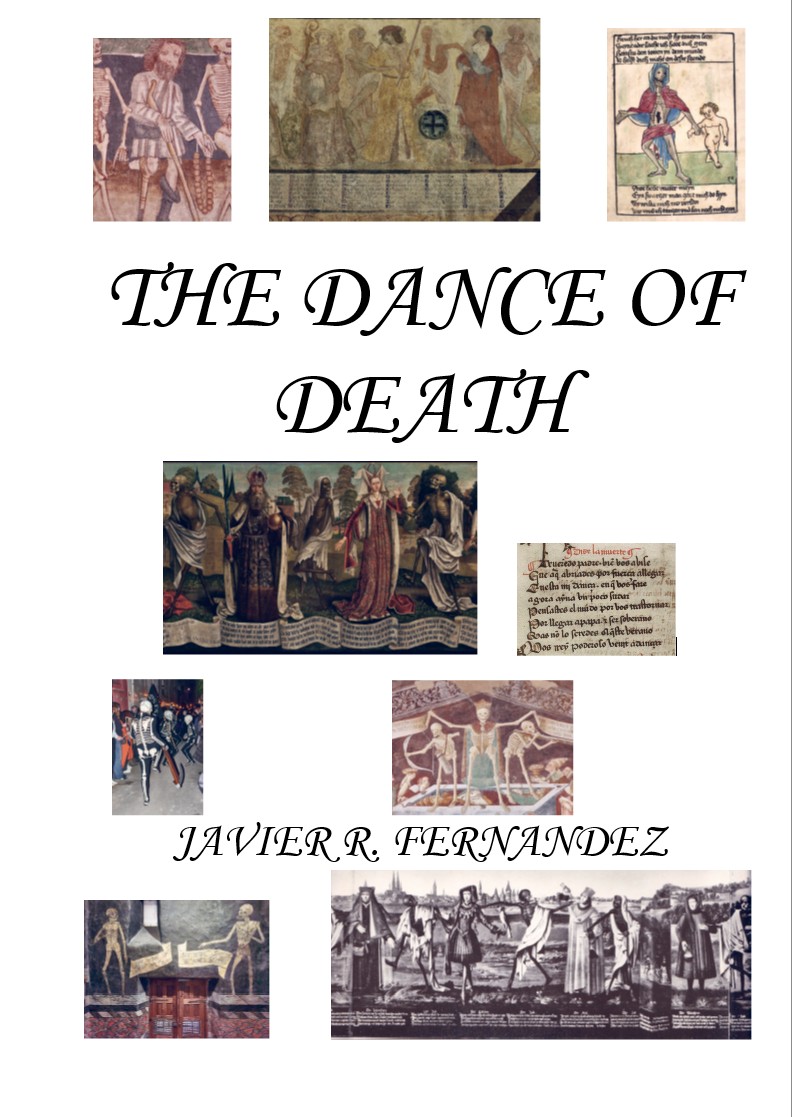
JAVIER R. FERNANDEZ
E-mail MARTE2050@yahoo.es
Website javierrfernandez.org
1st Edition 2,025
ISBN 978 – 84 – 09 – 45280 – 4
General Registry of the Intellectual Property M – 007548 – 2025
PREFACE
In the constant changes of history, the 5th century marked the end of Roman civilization, an event that changed the history of every place where it had been established.
This period is considered as the beginning of the Middle Ages in Europe, a period that would extend until the Renaissance in the 15th century, although in some places it began earlier.
As a result, the two great European powers of the time, Italy and Germany, lost most of their progress and opulence, on a path toward instability and war.
Over time, future states found themselves engaged in a continuous search for identity and a territory on which to establish themselves firmly. A difficult path that would only entail continued wars and all kinds of changes, with brief periods of unstable peace.
After the fall of the Roman Empire, the great influence of the Christian religion was the way that allowed the Christians to begin to combat paganism, the powerful belief prevailing among all the peoples who populated the lands of Western Europe.
Christians wanted to establish kingdoms dependent on the church, so that true power would reside in the religious world, called Christendom. This philosophy should establish two groups, the first charged with addressing the religious needs of the people under the guidance of the Pope, and the second one, that of the secular world under the direction of the emperor or king.
Obviously, these intentions were a continuous source of conflict, even with wars not only philosophical, but real. Despite all these events, the 12th century brought with it a period of prosperity, with cities increasing in size, better communications and safer travel, agricultural improvements, etc.
The 13th century marked the climax of the Middle Ages, a period that allowed society to reach its greatest splendour, even with the incessant and suspicious surveillance of religious and monarchical power.
Gothic art reached its pinnacle in sculpture and, most visibly, in the striking and marvellous cathedrals, which seemed to reach the heavens …
In the 14th century, France was the most important kingdom in Western Europe. However, instability was increasing due to the intentions of King Edward III of England to become king of the Kingdom of France, along with conflicts related to the Duchy of Aquitaine.
Around the year 1,337, the Hundred Years’ War began, which devastated the French lands for 116 years, although not continuously.
On both sides, five generations of kings fought for a throne, a period that brought profound changes in fundamental aspects of the future of Western Europe.
One of them was the consolidation of national identities in the two kingdoms, England and France. Furthermore, kings began to rule over feudal lords, although it was a long and difficult change. The politics and tactics of war were also affected, which meant the end of the powerful cavalry and the supremacy of artillery.
But it goes without saying that the most profound and devastating effect was on the population. Death was associated with war, hunger, gangs of mercenaries and criminals acting uncontrollably, and a social instability that deeply affected people, with a large decrease in population.
I
COMMENTS
Some reflections, comments …
Obviously, I’m nobody in the world of history and photography. There are many people with much more experience and recognition for their knowledge in these fields than me.
This book is simply a personal desire, a self-published book. I made it because I like photography, history, and this subject, The Dance of Death, deserves it.
So, this book is a humble work on this subject, carried out within my personal limitations related to photography, with my knowledge of history, and with the problems one encounters when trying to do this work.
Over the course of about three years, I travelled occasionally to the locations where I took the photographs, as my finances allowed. Always enjoying the rich experience of travelling, to know people, places, of course with good and bad moments.
Technically speaking, taking good photos in some places is difficult. In enclosed spaces, there are lights that shine directly on the paintings, a nightmare for a photographer.
These drawbacks can be solved. First, you need to have the necessary time to work.
Sometimes it’s even worse when you have to take photos with hardly any time, because the person in charge of the place is demanding that you finish right away …
Second, adequate artificial lighting can be provided or improved, and everything changes for the better.
Needles to say that, if you’re working with a book publisher, he’ll take the necessary steps to make sure that the location meets the necessary conditions for the photographer to work easily.
Consequently, she/he can get the perfect book that we can buy in the bookstore.
Obviously, this isn’t my case. In the end, things can sometimes get even worse, so, humorously speaking, each of these places can become a kind of survival lesson.
Well, the work continues at home. Hours and hours in front of the computer, trying to get the best out of the photographs, which end up in the digital space. Another personal nightmare if you’re not a professional in that field and need to take it step by step.
Well, I’ve finally finished working on the photos that will be included in the book, and… let’s compare them with the ones we found on the web… and what a curious surprise …
The photos you find on Internet are perfect, even better than the actual paintings !
Actually, my photos are worse, but I realize that they are what we see in the paintings, let’s say they are a perfect photo of what is there …
So, I choose to leave the photos as the paintings look, with their reflections and imperfections, this is what we see when we look at the paintings.
The photographs of Croatia, France, Germany, Italy, Poland, Slovenia and Spain ( Castillo de Javier ) were taken with the subsequent photographic equipment :
Camera body : Hasselblad 501 CM and 905SWC. Digital back Phase One P-30+. Lenses : Zeiss Planar CF2,8/80 mm ; Zeiss Makro-Planar CFE4/120 mm ; Carl Zeiss Sonnar 5,6/250 mm
The photographs of Morella were taken with the subsequent photographic equipment :
Camera body : Nikon F800. Lens AF Nikkor 180 f2.8 ED-IF.
The photographs of Girona were taken with the subsequent photographic equipment :
Camera body : Nikon F800. Lens : AF Zoom-Nikkor 35-70 mm f2,8D 1
ESTONIA
TALLINN NIGULISTI KUNSTMUUSEUM
See “Germany. Lübeck Marienkirchen” for further comments.
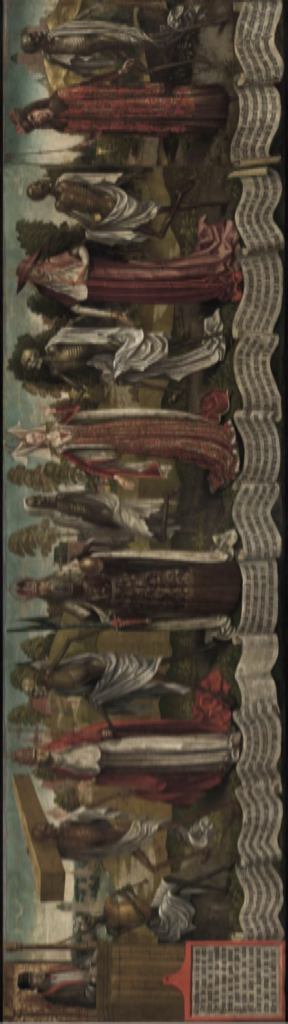
Notke followed the Lübeck model in 1,500, painting his second Dance of Death on canvas, which had been in St. Nicholas Church in Tallinn since the 17th century.
In this church was the St. Matthew Chapel, of 32.8×16.4 feet.
If the painting followed the Lübeck model, it should have 24 dancing couples.
This second painting was 98 feet long.
Consequently, the Chapel of St. Matthew did not have sufficient space for the painting.
The Chapel of St. Anthony was built around 1,490, and it was larger, 32.8×49.21 feet, but also lacked sufficient space for the painting.
So it’s possible that the original painting was cut into pieces and that we now only
know two of those parts.
The resulting frame is only 24.7 feet long, and appears to have been the result of joining a 21-foot-long part and a 3.7-foot-long part in 1,843.
A careful study of the final painting shows us details that are not entirely correct.
In the space between the king’s right side and a dead man, the landscape doesn’t fit perfectly.
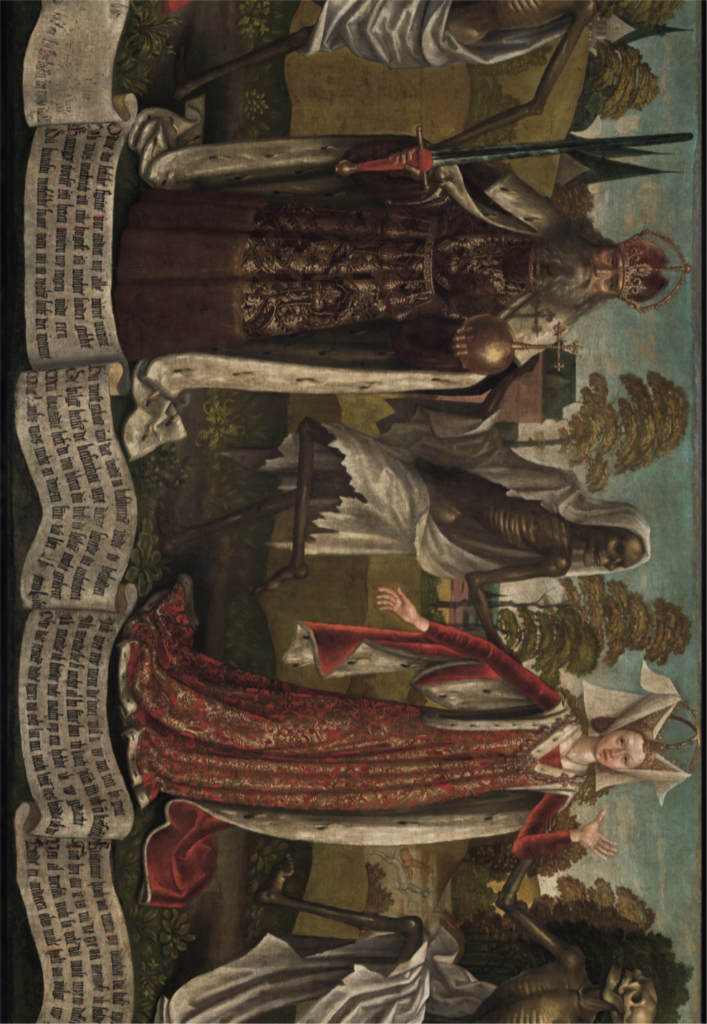
Furthermore, the dead man has no contact with the king, when usually the dead man touches two people, one with each hand.
A preacher, on the left side of the painting, looks with a serious expression at the living beings and dead people dancing below him.
After the preacher appears a dead man sitting comfortably playing a bagpipe, followed by another carrying a coffin.
Here we see a difference from the first painting, where the dead man played a fife.
We’re not sure why this change occurred, perhaps because bagpipes were believed to awaken the dead.
A dead man, carrying a coffin on his right shoulder, grabs the Pope’s clothes, as if inducing him to participate in the dance.
Thus, after the Pope wearing a papal tiara, we find the Emperor with an orb and a sword, a beautiful Empress, a Cardinal and a King.
Below the characters, we see the dialogues between the dead person and each person, written in Low German language.
St. Anthony´s Chapel was destroyed in a bombing during the Second World War, in 1,944. Fortunately, the painting was damaged but not destroyed, and it was sent to Moscow for restoration in 1,962.
4
5
PREACHER AND POPE
6
THE POWERFULL
EMPEROR, CARDINAL, KING, PAPAL LEGATE, CONSTABLE, MITRED
ABBOT, KNIGHT
10
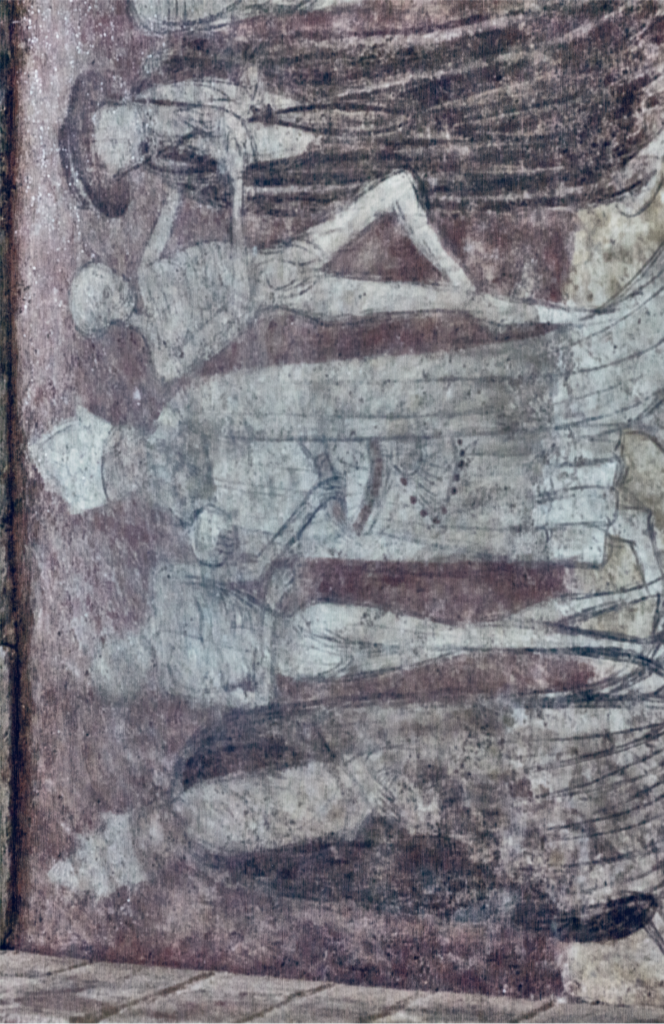
THE POWERFULL
POPE, EMPEROR, CARDINAL
13
LA FERTE-LOUPIERE EGLISE SAINT-GERMAIN
At the beginning of the 12th century, the church of Saint-Germain was built in the green countryside of La-Ferté-Loupière.
During the following centuries it underwent various modifications and currently only the entrance portico, in Romanesque style and on both sides of the main nave the first three semicircular arches, remain of the original building.
Towards the end of the 15th century, four paintings were painted : St. Michael slaying the dragon, the Virgin of the Annunciation and a Dict of the Three Dead and the Three Living ; the latter are found at the beginning of the painting of The Dance of Death that, 8,284 feet long, shows 42 characters.
A white background makes The Living stand out, with costumes in striking shades of ochre, pink, violet, green, etc.
Fortunately, the wall was covered with whitewash, which protected the paintings, dating from the early 16th century, until 1,910 when they were rediscovered and finally restored in 1,953.
As usual, we look at the fresco starting from the left side.
A storyteller introduces people to subsequent characters, along with 3 skeleton musicians playing a bagpipe, a portable organ and a harp.
The social hierarchy of the medieval period is, as always, clearly evident.
So, the order is : Pope, Emperor, Cardinal, King, Legate, Duke, Patriarch, Archbishop, Constable, Bishop, Lover, Lawyer, Singer, Priest, Farmer, Franciscan Friar, Child, Cleric, and Hermit.
25
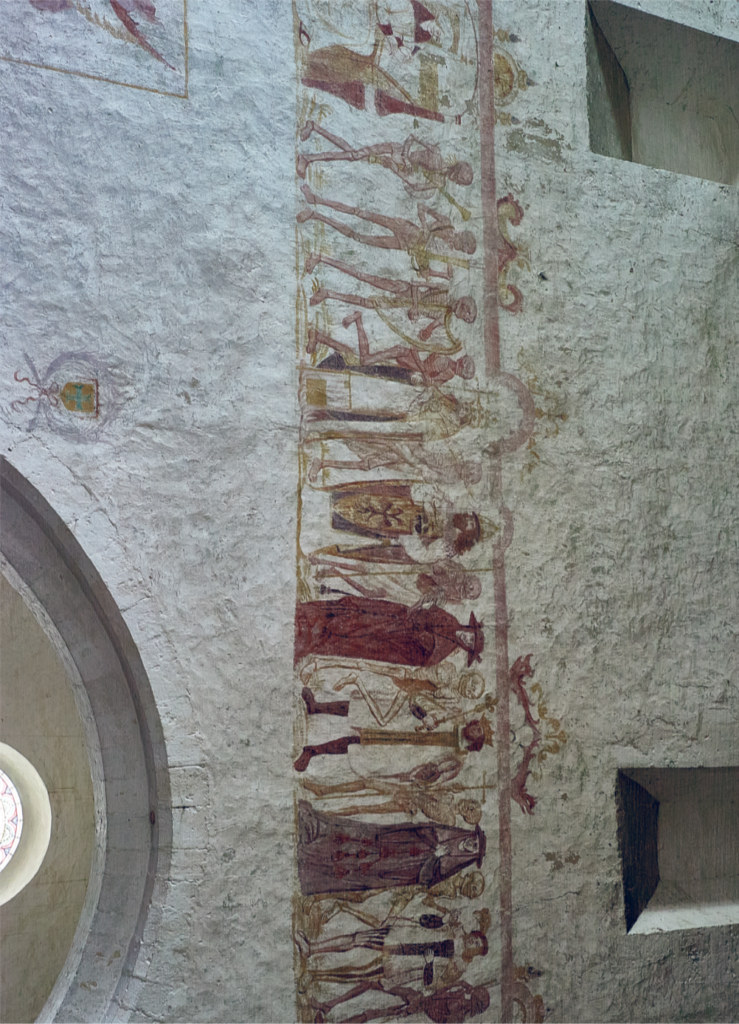
STORYTELLER, SKELETON MUSICIANS, POPE, EMPEROR, CARDINAL,
KING, LEGATE, DUKE
26
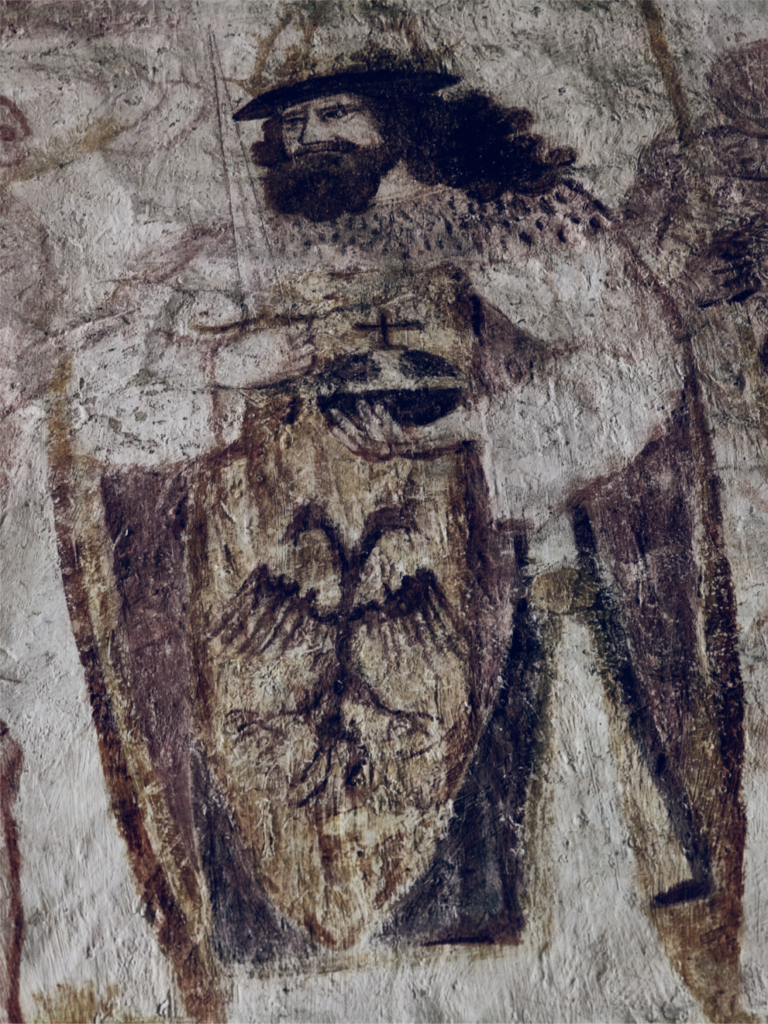
EMPEROR WITH A SWORD AND A GLOBE
30
SEMUR-EN-AUXOIS CHAPELLE SAINTE-APOLLINE
The Sainte-Apolline chapel, of a simple architecture, stands in Brianny, a small village inhabited by about a hundred people.
It is a small building, rectangular in design, built around the year 1,140, probably an ossuary at first.
The roof structure is concealed by a panelled ceiling, and three windows illuminate the interior of the chapelle.
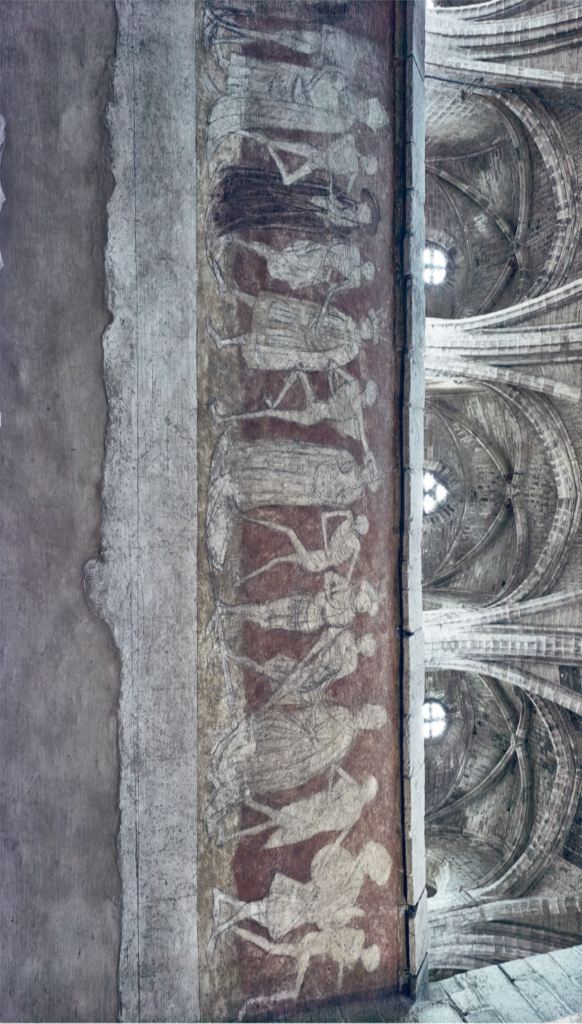
The internal walls were painted in the 16th century with a representation of The Dance of Death, showing living and dead couples, as a sample of medieval society.
Logically, the mural paintings have been affected by the passage of time, humidity and the general state of the chapel. Some of them show an acceptable state of preservation, while others are severely deteriorated.
It is possible that these mural paintings follow the model of the Saints-Innocents cemetery in Paris, with separated walls dedicated to women and men.
Following the tradition of the Dance of Death, each person is accompanied by a skeleton, which guides her or him towards the inevitable destiny of death, the same for everyone, regardless of social status.
There are 29 pairs of living and dead people and, unusually, as many women as men.
It is not easy to accurately recognize some people.
Starting by the left side of the East wall, there are two women. The style of the painting suggests that it could be a woman with her daughter, possible local sponsors of the paintings. After them come the Pope and the Emperor.
The South wall comes after. We see a cardinal, a king, a constable, a bishop, a black monk, a bailiff, an effaced person, a dead man with a spade, a man-at-arms
The West wall shows a sergeant, a minstrel, a ploughman, a pilgrim, a usurer, a dead child.
The North wall shows a varied representation of women. A duchess, a regent, a widow, an abbess, a merchant, a widow with clasped hands, a faded character, a pregnant woman and her daughter, a recommender, a nurse, a villager, a coquette, a madwoman.
Being in the countryside, in a small church like this, it’s easy to think about the living conditions of the peasants and the influence that the external events of the Middle Ages had on their minds.
We can imagine the priest at mass, the sermon to his parishioners, on a windy and rainy winter day.
It’s cold outside and inside the church, the constant threat of wolves looms over the small village.
The dim light of the torches illuminates the paintings of the dance of death, and the priest crying out against the sins of people, the cause of all the calamities that surround them …
48
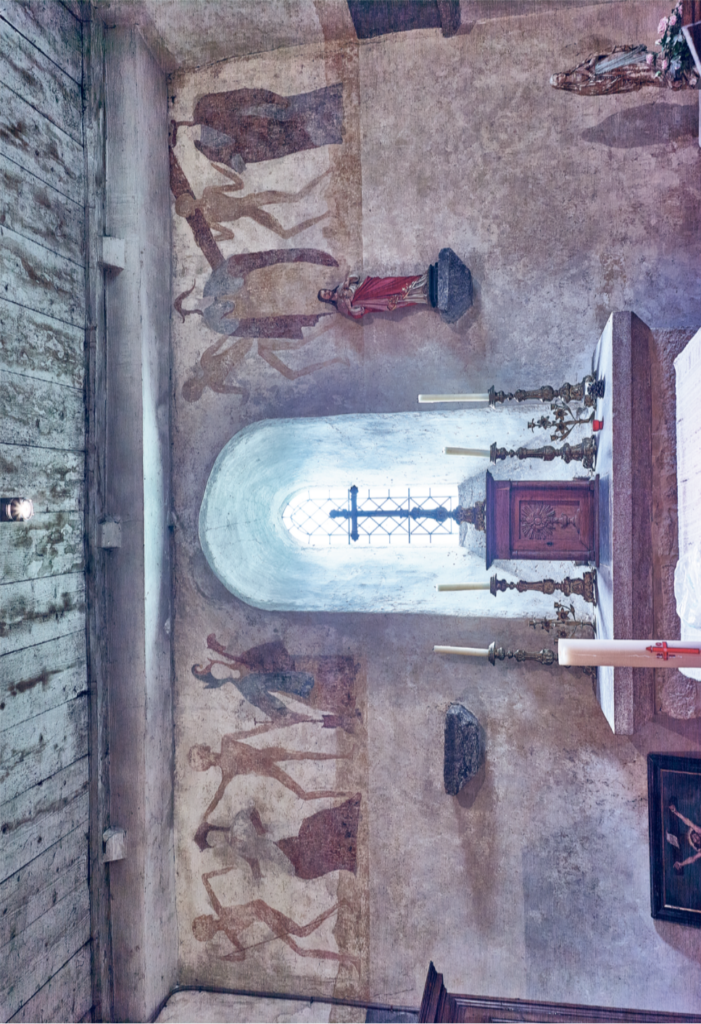
EAST WALL
DONORWOMAN AND HER DAUGHTER, POPE, EMPEROR
49
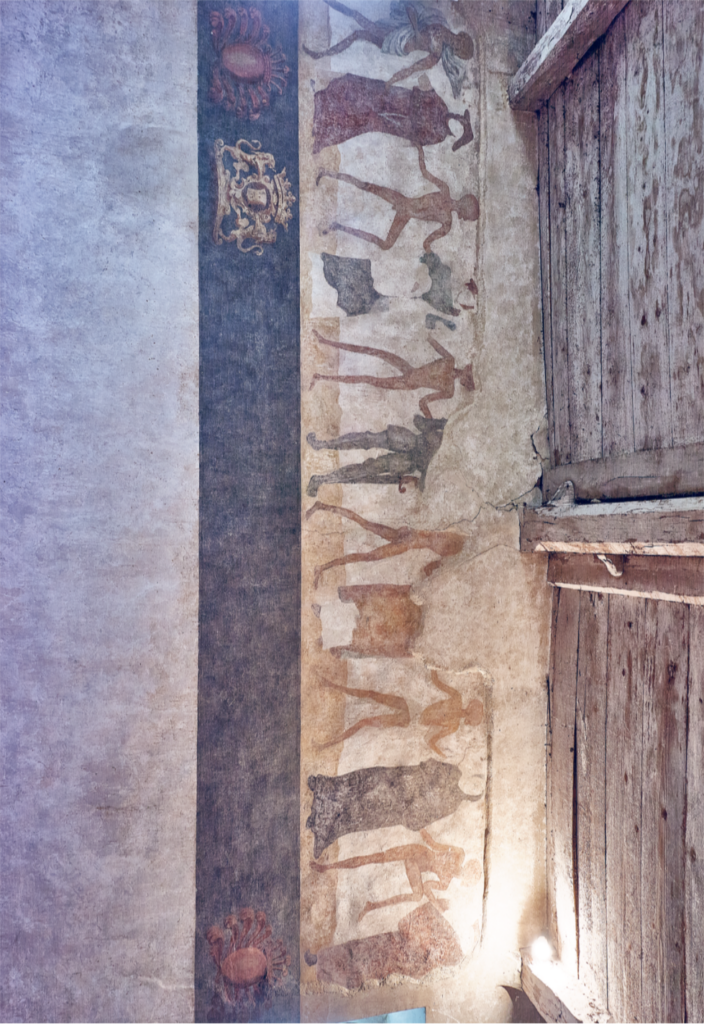
SOUTH WALL MEN´S WALL
CARDINAL, KING, MAN-AT-ARMS, BISHOP, BLACK MONK, BAILIFF
50
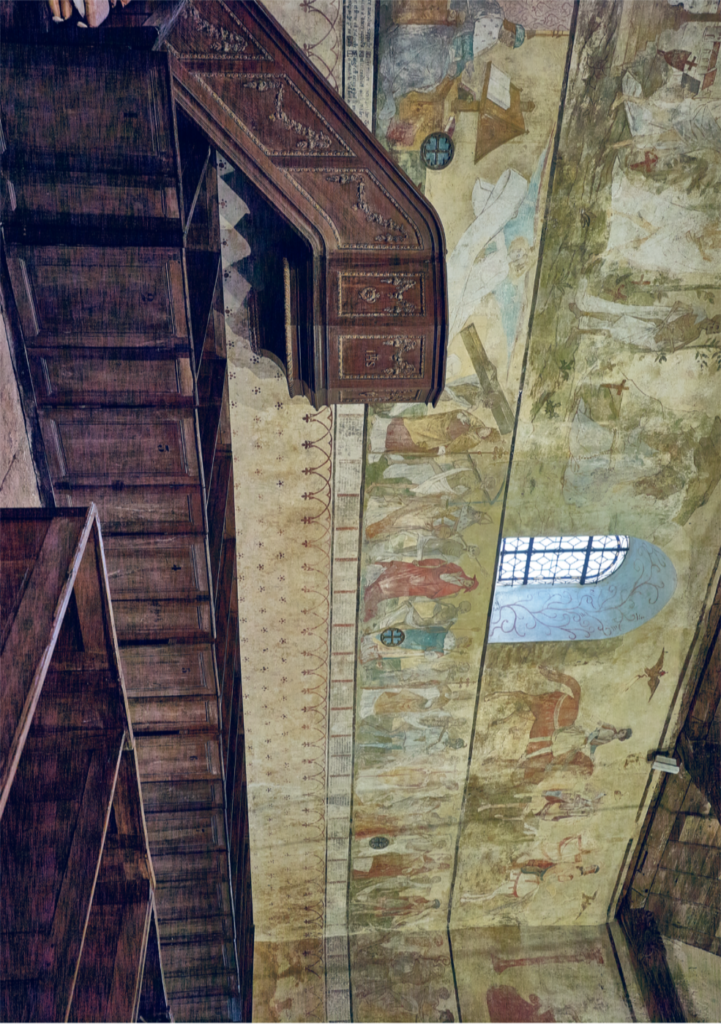
SOUTH WALL
ABOVE THE DANCE OF DEATH, THE TALE OF THE THREE DEAD AND THE
THREE LIVING
58
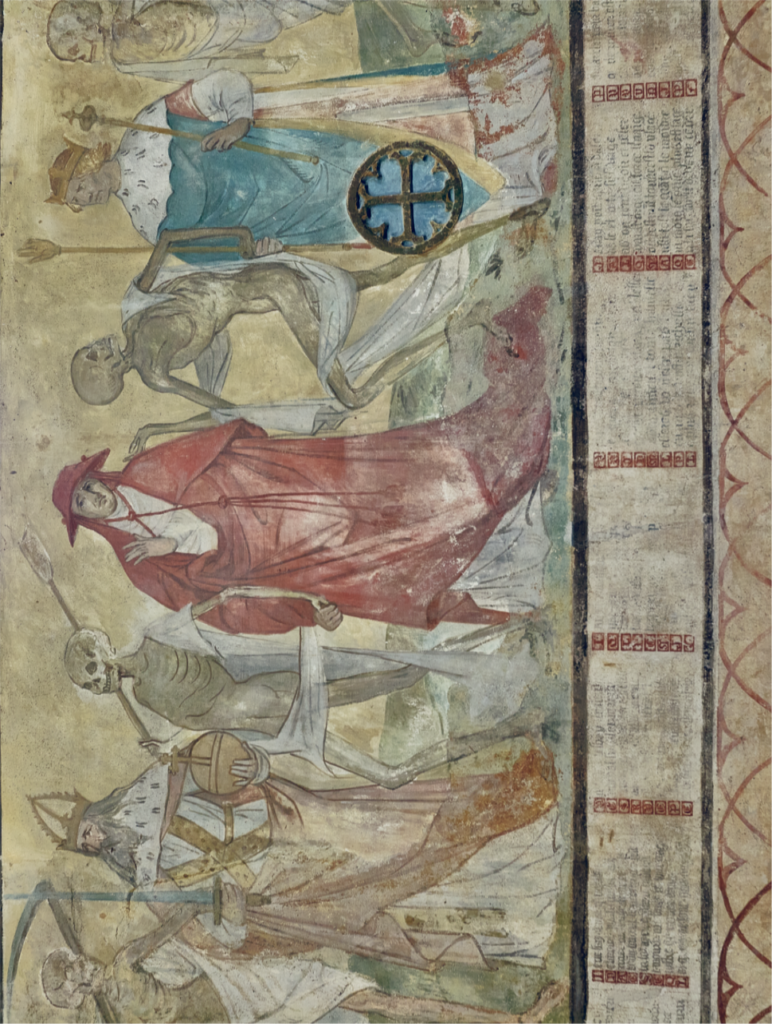
SOUTH WALL
EMPEROR, CARDINAL, KING
65
KERMARIA-EN-ISQUIT CHAPELLE DE LA VIERGE MARIE
Participating in the Crusades to the Holy Land was a serious and very dangerous venture. Thus, when Count Henry of Avaugour returned safely from Palestine in 1,240, he thanked the Virgin Mary by building a chapel in his village of Kermaria-en-Iskuit, in Brittany.
Since its foundation, the chapel was dedicated to the worship of the Virgin Mary, i.e. Itron-Varia-an-Isquit, Mrs. Mary who emerges from difficult situations, who safeguards.
As usual, the chapel was modified and expanded over the centuries .
The passage of time also brought with it some curious details. For example, the stone benches in its beautiful portico were the place where the church council regulated village life. In addition, a floor was built to house the mansion’s archives and courthouse, and a finely carved balustrade was used as the place from which justice was administered.
Under the direction of the monks of Beauport Abbey, the chapel became a center for pilgrimages and fairs, an important source of income for both the religious and the village.
In the 19th century, the priest of Plouha attempted to destroy the chapel and build a larger church, but was met with opposition from the villagers.
Between 1,488 and 1,501, an unknown painter or painters painted The Dance of Death in tempera, on the arcades of the chapel. As in another places, the paintings were covered with whitewash in the 18th century.
This fact helped to maintain the paintings in good state, until 1,856 when they were rediscovered and, besides, saved the chapel from demolition. Ironically, once the protection of the whitewash is lost, humidity damages the paintings.
The paintings of the originally 47 characters begin above the arcades, next to the choir, on the north, south and west walls. Unfortunately, some of the characters have been lost.
In an original design, each character is in the middle of two columns, highlighted against a reddish-brown background.
In the dance, clergy and lay people often alternate.
The paintings of the dead are very simple and of poor quality. They are in different positions, with their hands touching the living beings.
Surprisingly, some of them have heads that are strikingly deformed compared to their bodies, creating an inevitable sense of repulsion, perhaps even fear.
On the south wall, the dead to the right of the Archbishop has a shroud ; of all the dead, he is the only one wearing something.
In another detail of the south wall, the dead who touches the knight does not touch the bishop, and furthermore, he has a hoe.
North wall. Some say the woman’s position alongside the doctor is unclear. Doctors hold the highest positions in society, so this woman could represent Death.
North wall. Some believe the skull of the dead man between the lover and the musician appears to be a frog.
As usual, the Preacher leads the dance, his words following a text.
It is an eight-line Gothic script, restored in 1,861, with the words of the Preacher, Cardinal, the King, the Patriarch, the Constable, the Archbishop, the Knight and the Bishop.
73
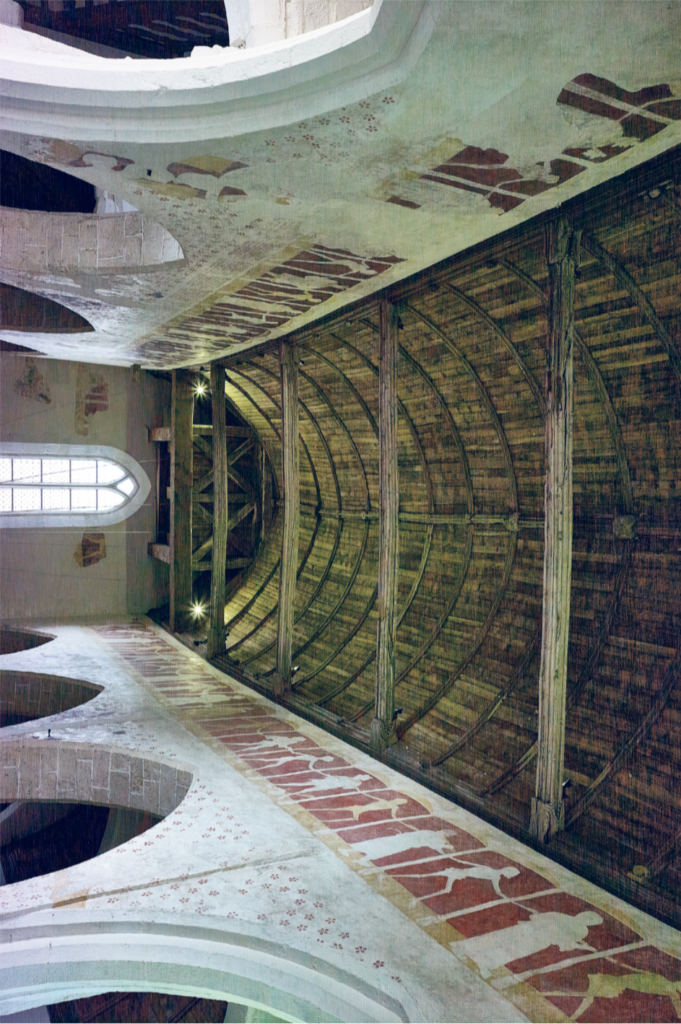
THE INTERIOR OF THE CHAPEL WITH ITS STRIKING WOODEN VAULT
74
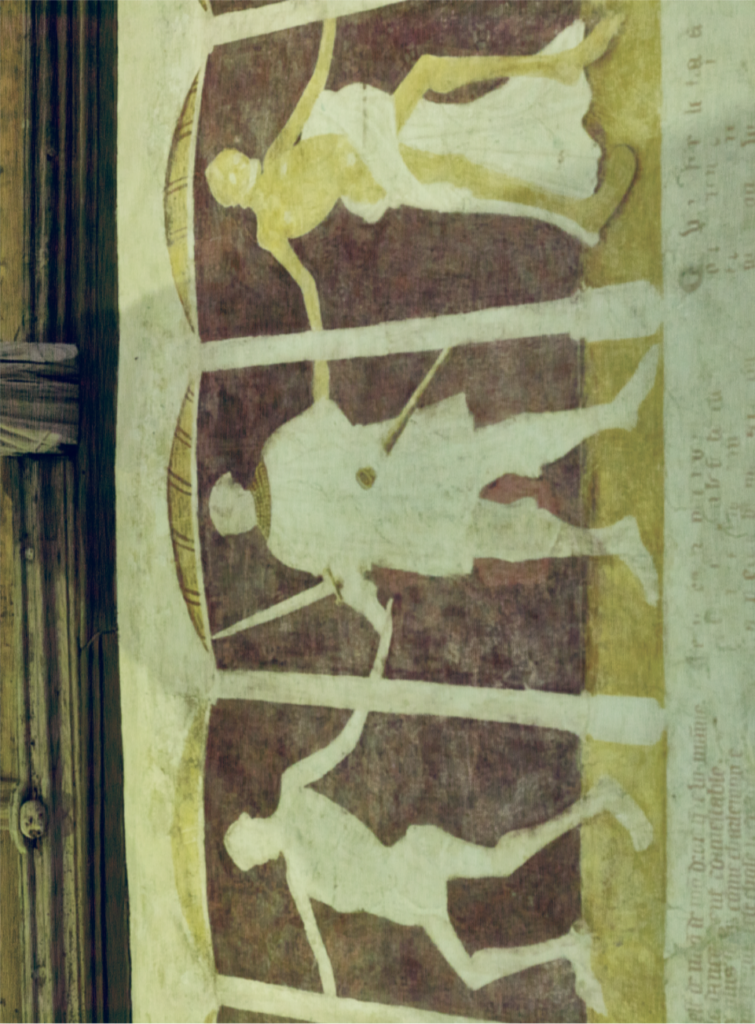
SOUTH WALL
CONSTABLE, DEAD WITH A SHROUD
83
KERNASCLEDEN EGLISE NOTRE-DAME
In the Middle Ages, donations from nobles were a common way to construct a religious building.
Thus, around 1,420, the Duke of Brittany and the Rohan family provided the necessary funds for the construction of the chapel of Notre Dame in Kernascleden.
Their coats of arms on the keystones were a gesture from the religious class to them, in gratitude for this act.
The chapel was completed in 1,464 and, through the transformations it underwent over the centuries, became the finest example of flamboyant art in Brittany.
As a comment, it is known as the chapel of the 100 bell towers.
A frieze of the Dance of Death was made around 1,450, by an unknown painter or painters.
As with other chapels and churches, the passage of time took its toll, and now only fragments of the original 15 living and 16 dead remain.
Although it is difficult to be sure, these living beings could be a Cardinal and a Knight.
92
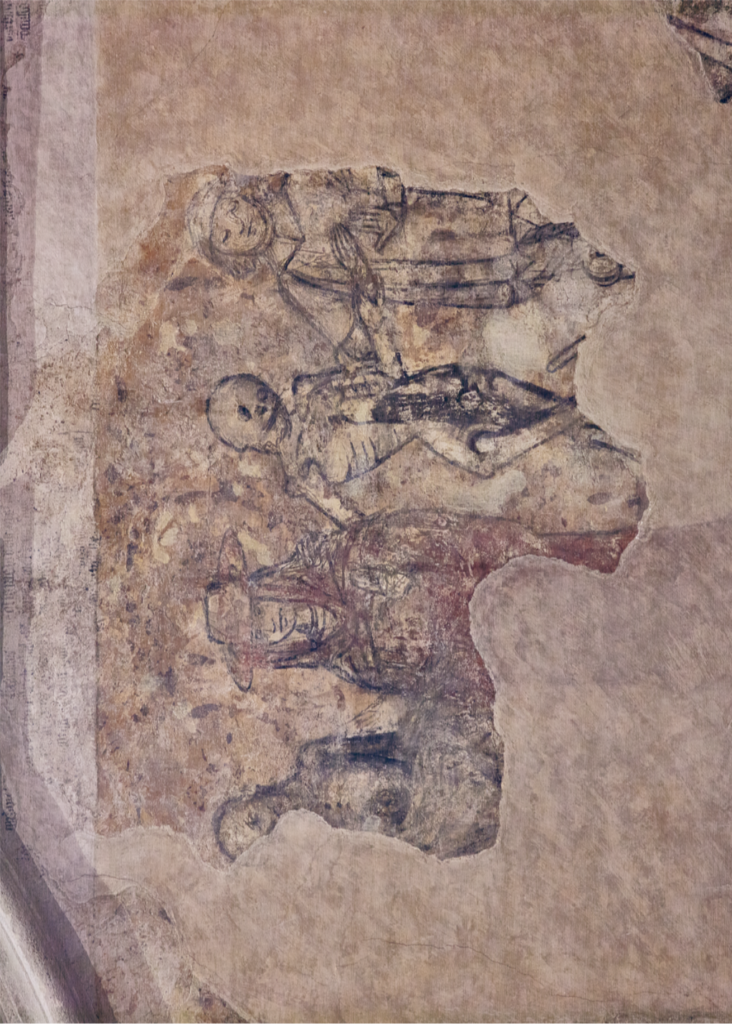
CARDINAL, KNIGHT
93
GERMANY
HEIDELBERG UNIVERSITAT HEIDELBERG
The oldest books made in Europe involved a long and painstaking process, usually made by monks in the monasteries, with texts and illustrations made by hand.
No doubt, they were masterpieces.
After 1,445, Gutenberg’s movable type printing press became the most common form of book publishing, due to its technical advantages over earlier printing techniques.
However, at that time the blockbook or codex, made in Holland around 1,420, was very widespread, due to its lower cost.
As was most common, the content of that books was related to religious themes.
The process of making a blockbook is known as xylography, when the content was printed onto a page from a block of wood.
The wood is engraved and gouged out, and consequently text and illustrations appear in relief.
The next step is to ink them and place them on a double sheet of damp paper.
In any case, books printed on woodblocks were not cheap, as paper was expensive; but despite its drawbacks, it was the most common method for producing large quantities of books.
The Universitätsbibliothek Heidelberg houses Codex Palatinus Germanicus 438, a German woodblock made between 1,455 and 1,458.
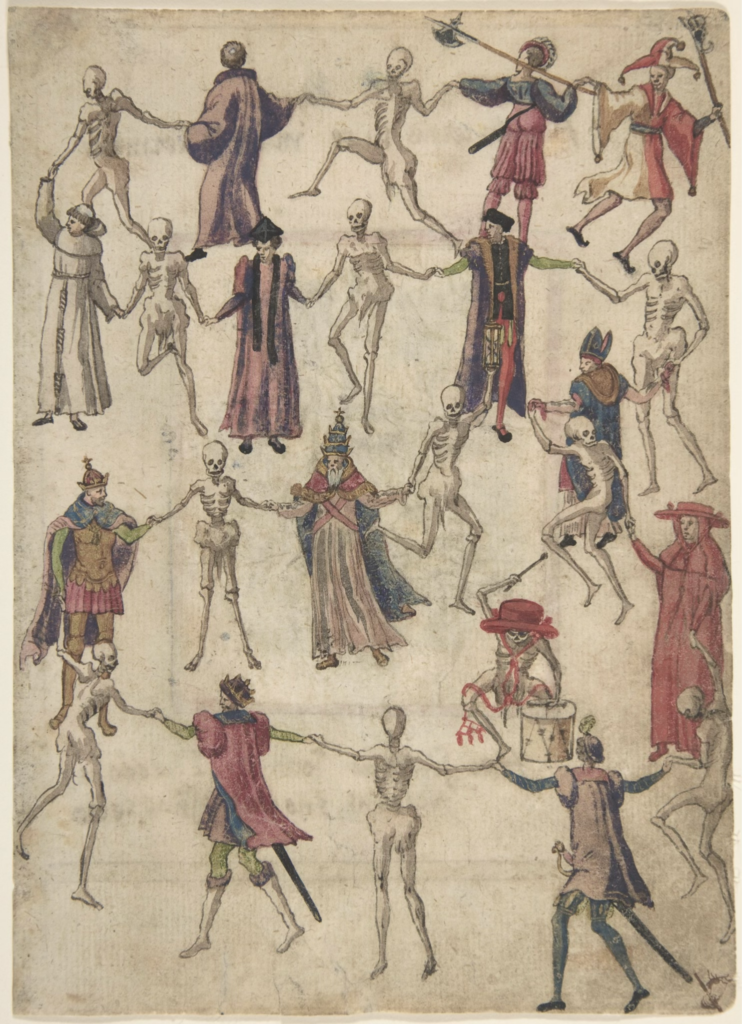
The codex provides general information about daily life during that period, along with 25 hand-colored illustrations of the Totentanz, or Dance of Death.
This codex aligns with other works related to the Dance of Death, depicting figures arranged according to their social standing, accompanied by verses that describe the unavoidable facts of death.
94
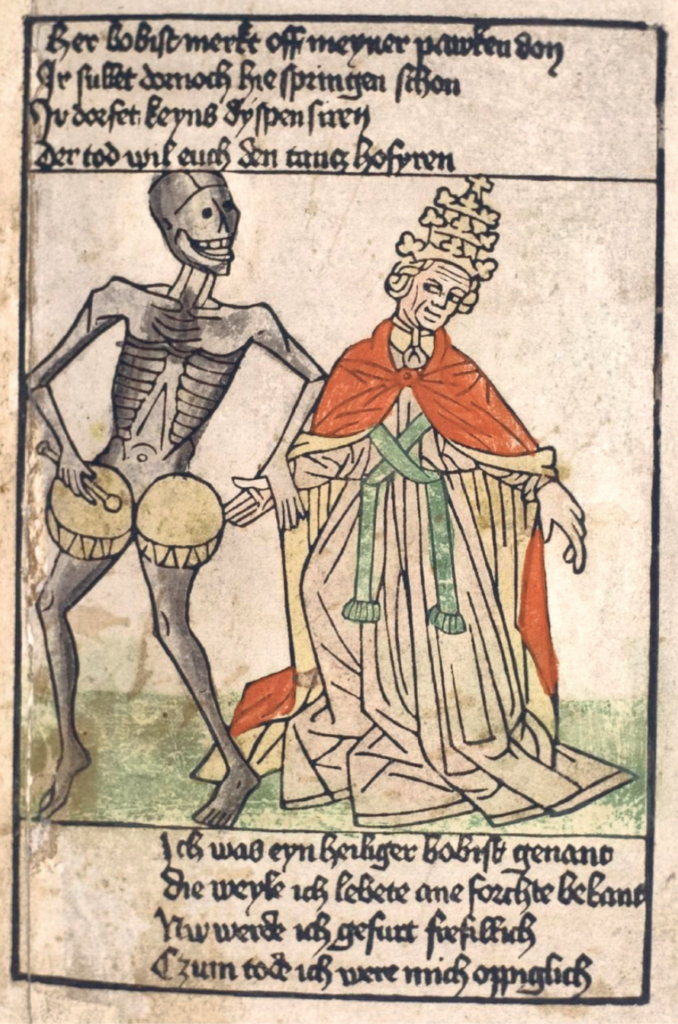
POPE
95
GERMANY
LÜBECK MARIENKIRCHE
Bernt Notke was a German sculptor and painter, born in 1,435 in Lassan.
His two most famous paintings on canvas, related to the Dance of Death, are the only surviving medieval ones.
Coming from the south, the Black Death reached the German city of Lübeck around 1,464, and in 1,477 Bernt produced his first mayor work, the Dance of Death, for the Church of Mary.
The painting, 85 feet long and almost 6.5 feet high, was on a linen wall covering.
Its style, number of dancers, etc., resembles that of the Cimetière des Innocents in Paris, displaying the philosophy of the Christian doctrine regarding the death.
A dead that plays fife is at the beginning, followed by other one bearing a coffin.
Some 24 life-size couples, characters of the time, where represented along with their skeletons, from the most important to the most humble : pope, emperor, farmer, etc.
This painting has also a different scenery of other dances of death, showing the landscape of Lübeck.
Although we do not know how colorful the Lübeck painting was, the St. Anthony’s Chapel in Estonia’s St. Nicholas Church houses a painting, believed to be Bernt’s second Dance of Death, giving us an idea of how could it be.
Below the people, a text in Low German narrates the conversation between living people and their skeletons.
Unfortunately, this masterpiece was no adequately maintained, and in 1,701 it was replaced by a copy made by Anton Wortmann, very carefully made, but with some changes.
The texts were also affected by this change, and the poet Nathanael Schlott wrote new verses according to the fashion style of his time.
These verses were very different from the previous ones, which showed the joy of living, along with the fear of the Last Judgment typical of late medieval mentalities.
In 1,942, during the Second World War, the city of Lübeck was bombarded and almost totally destroyed.
The Notke´s painting was also destroyed, and only remained black and white photographies, drawings, descriptions and lithographs of it.
This is a difficult subject, and for this book I use information from photographs and lithographs provided to me by the Dane Martin Hagstrøm.
The modern works of Alfred Mahlau and Markus Lüpertz are reminiscent of the ancient painting.
120
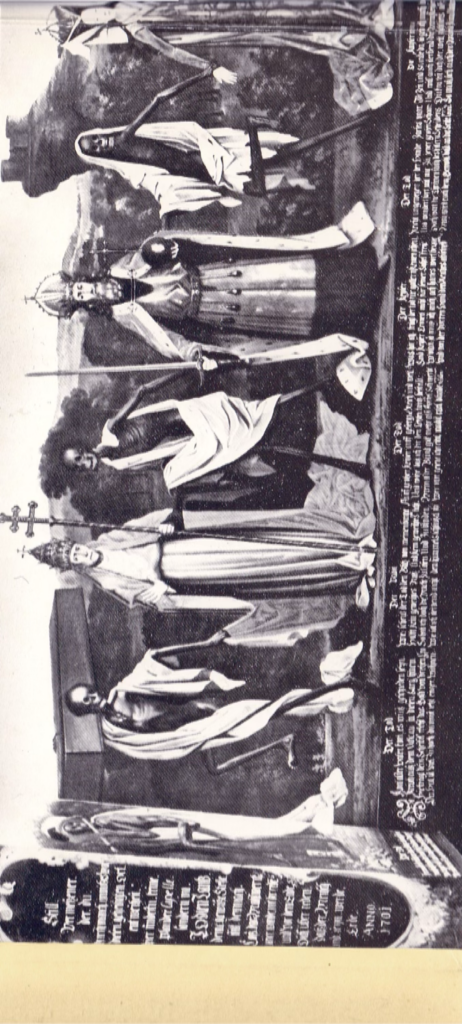
DEAD WITH A FLUTE, DEAD WITH A COFFIN, POPE, EMPEROR
121
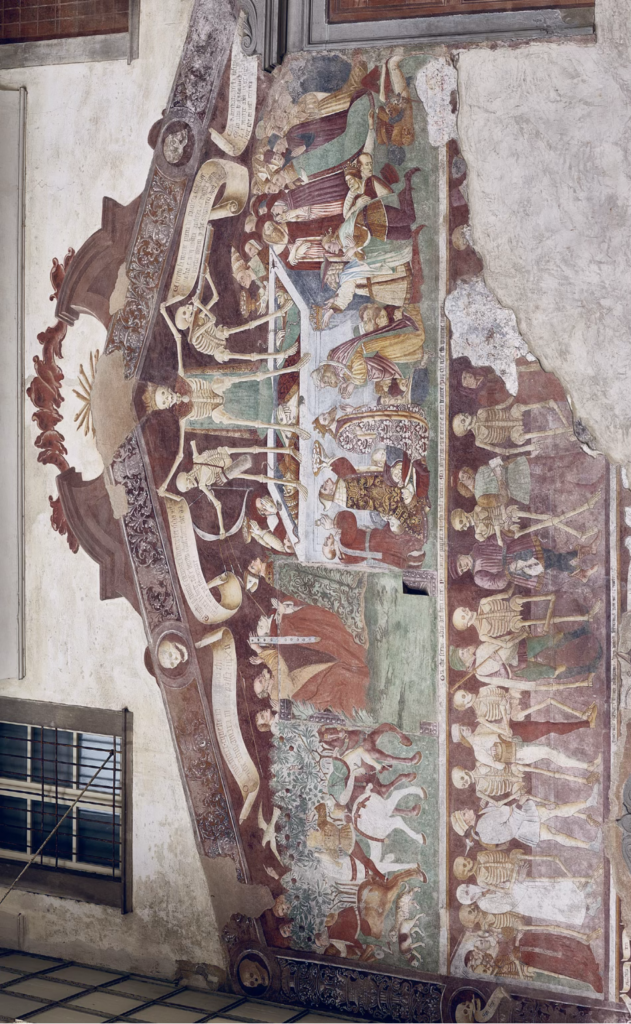
WEST WALL OF THE BASILICA
129
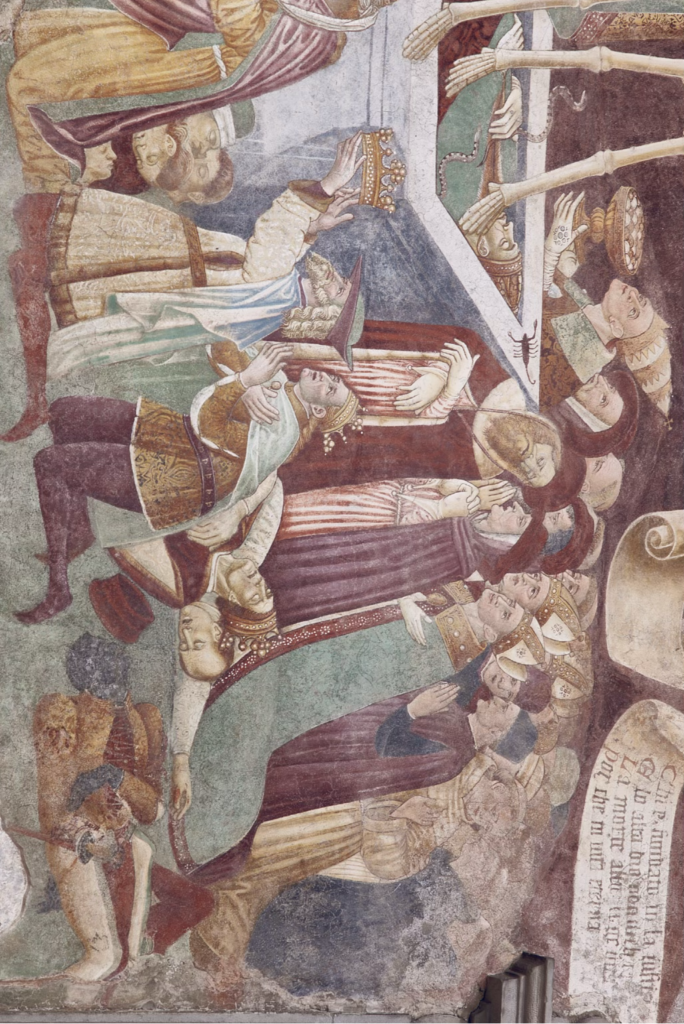
CARDINAL, BISHOP, FRIARS OF DIFFERENT ORDERS, DEVOTEES
132
CARISOLO CAPELLA DI SANTO STEFANO
The Capella di Santo Stefano is located on a granite cliff overlooking the Genoa Valley, in the beautiful Parco Naturale Adamello Brenta.
The church was built around 1,244, on the remains of an ancient castle.
The south exterior wall displays a 65.6-foot-long fresco painting of The Dance of the Dead by Simone Baschenis in 1,519.
Baschenis created his paintings with the aim of making churches more attractive for worship, with paintings rich in color.
Unfortunately, during one of the church’s modifications over time a staircase was built into the south wall, damaging the paintings.
Besides, due to the harsh climate of these mountains, the paintings have been damaged over time.
138
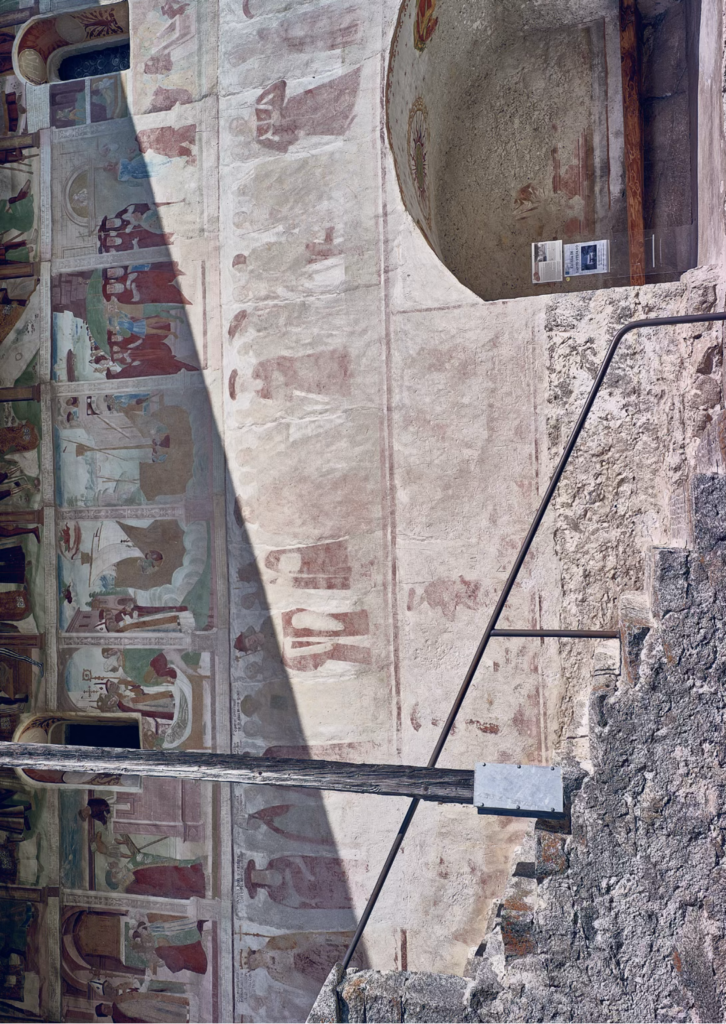
SOUTH WALL
139
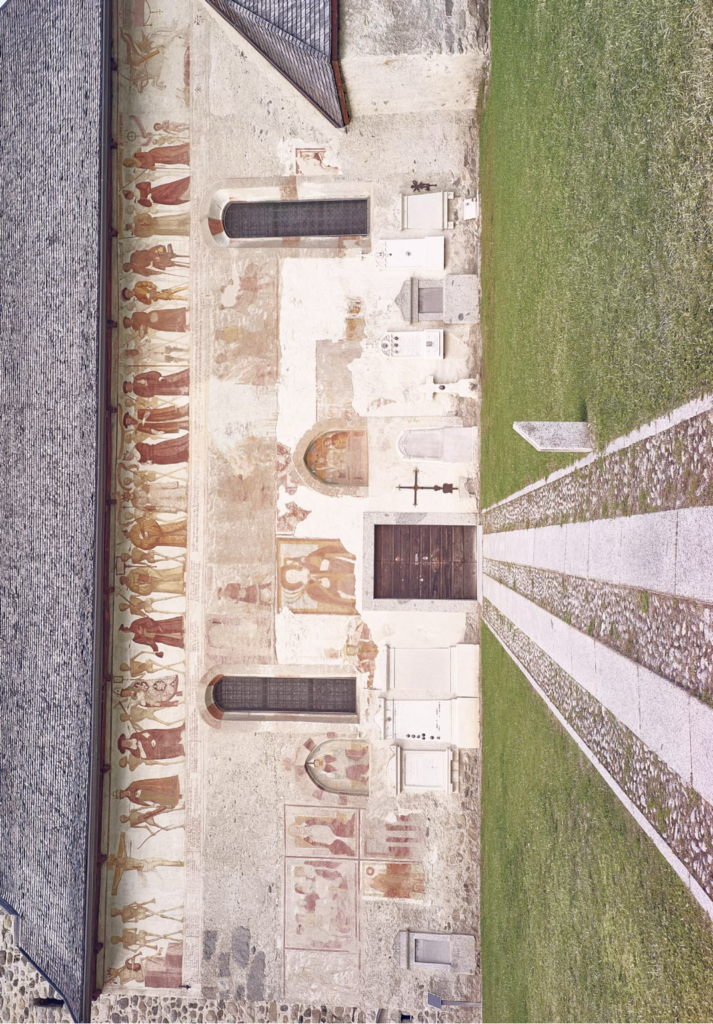
MAIN FACADE
145
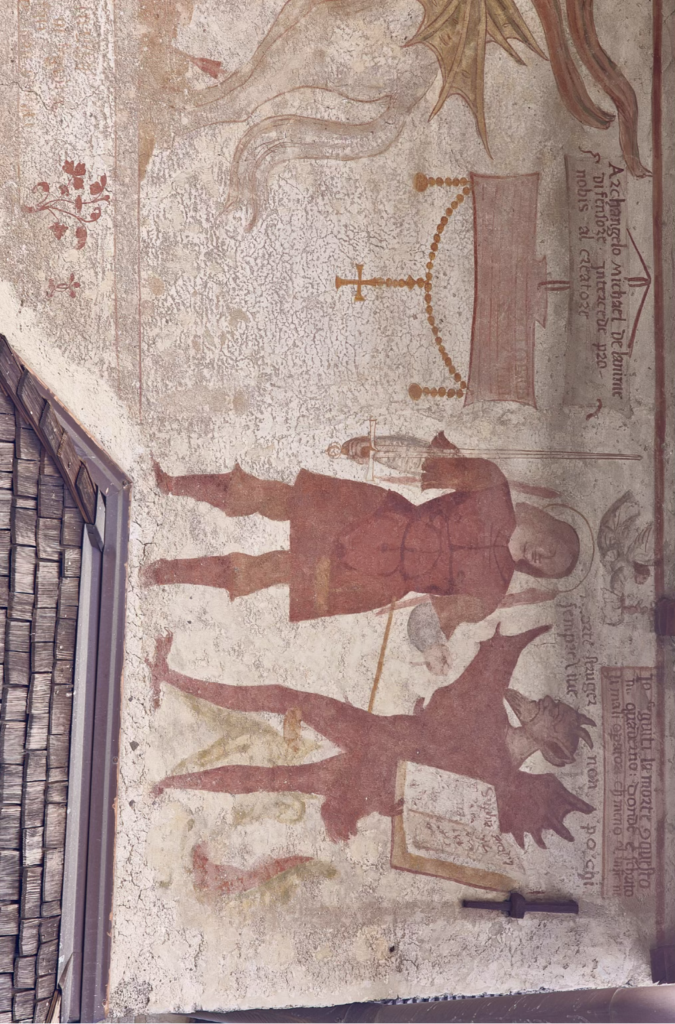
ARCHANGEL MICHAEL AND LUCIFER WITH THE BOOK OF THE SEVEN
DEADLY SINS
156
PLAUS CHIESA DI SANTA MONICA
In the mountainous South Tyrol, in Val Venosta, lies the small village of Plaus.
Its parish church of Santa Monica, built in 2,017, has a cemetery on whose exterior walls the artist Luis Stefan Stecher made 18 fresco paintings related to The Dance of
Death, although with a personal and modern point of view.
These paintings have verses, written in the local dialect, that briefly explain them.
Always keeping Death in mind, Stefan mixes different themes, such as those related to social outcasts, agricultural traditions, details of the region, etc.
Starting by the left side as we see the wall :
– Death calls men to its domain
– The Pietà
– Death knows how to wait
– Death and Love
– Death pours the wine
– Death cuts down a tree with an axe
– The Knight and Death
– Death makes no distinction between social classes
– Death also calls children to him
– Death appears with the scythe and animals
– The Masks
– Deaths play with violins
– The Dance of Death
– Deaths Carrying a Corpse
– Death pulls a chariot
– We are all equal in the face of death
– Death and Motorcyclists
– Death as Farewell
157
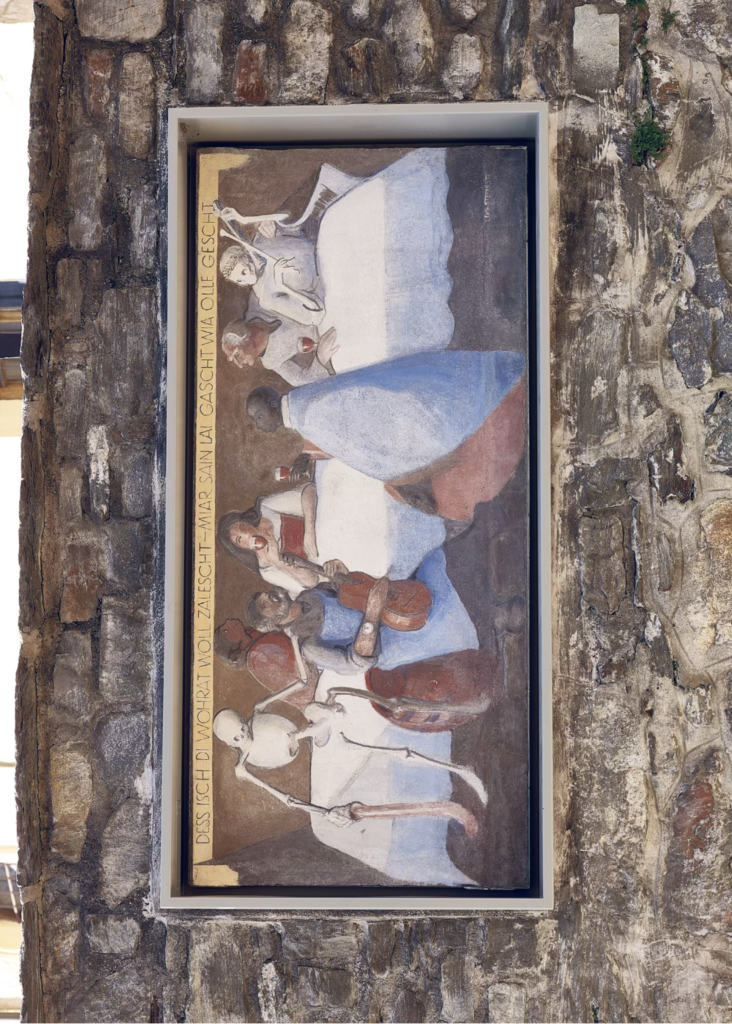
DEATH POURS THE WINE
People sit happily around the table, enjoying the wine. But Death accompanies them. The
inscription says : «This is finally the truth: we are guests like everyone else.»
163
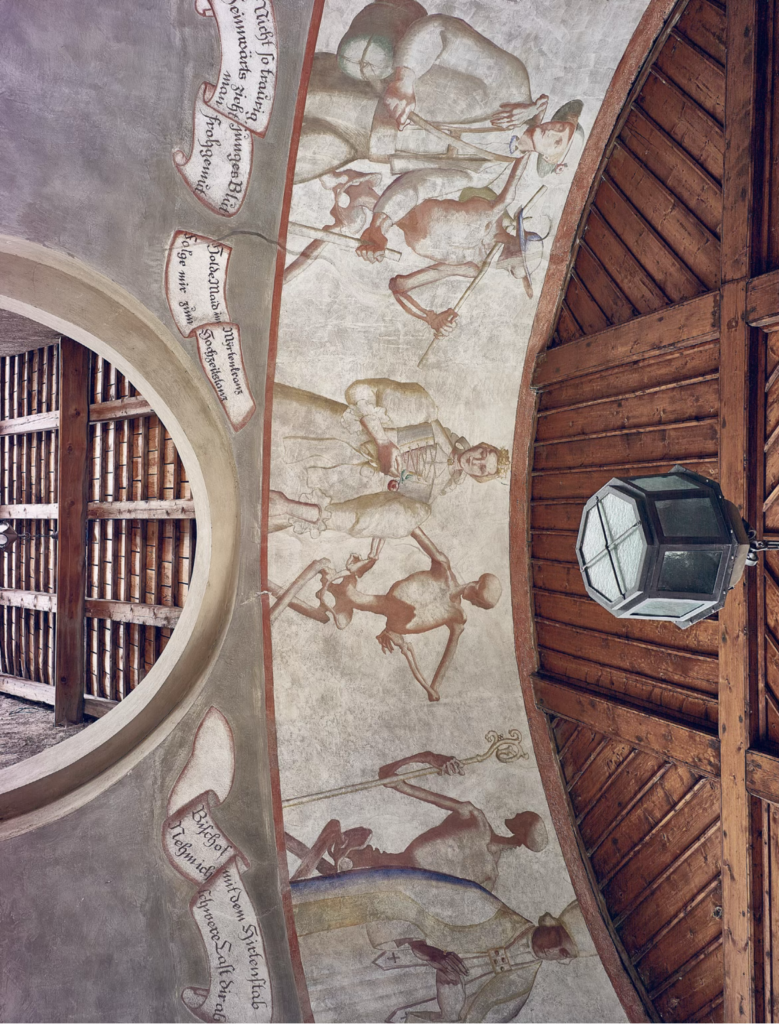
YOUNG MAN, YOUNG WOMAN, BISHOP
180
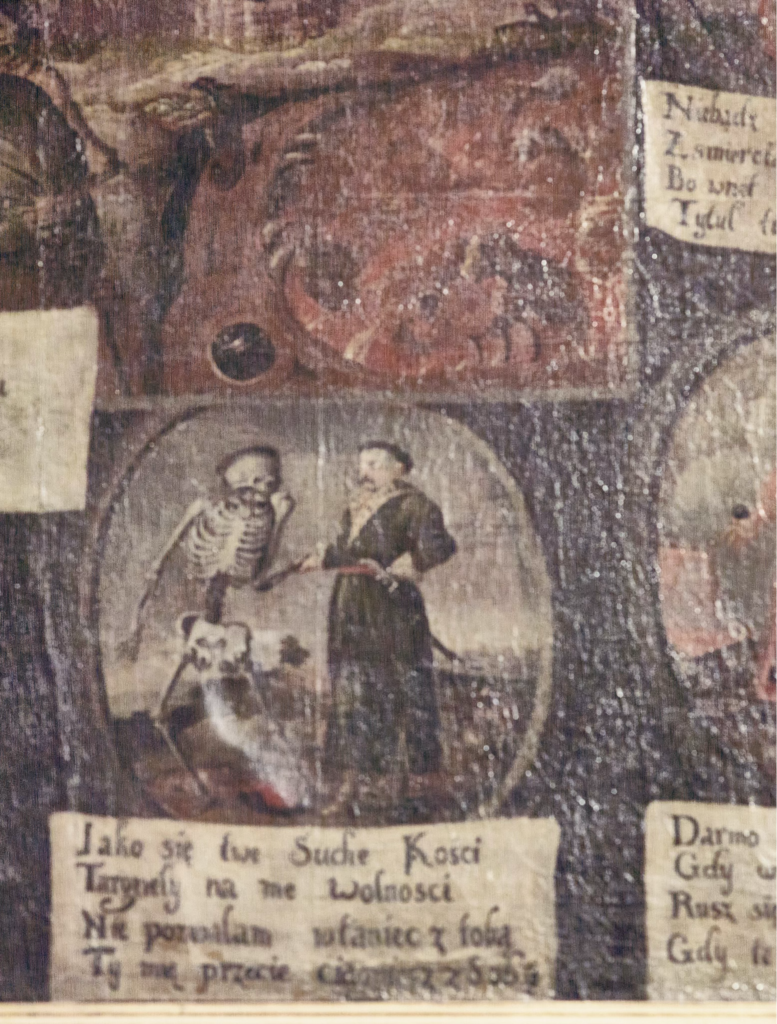
NOBLEMAN
197
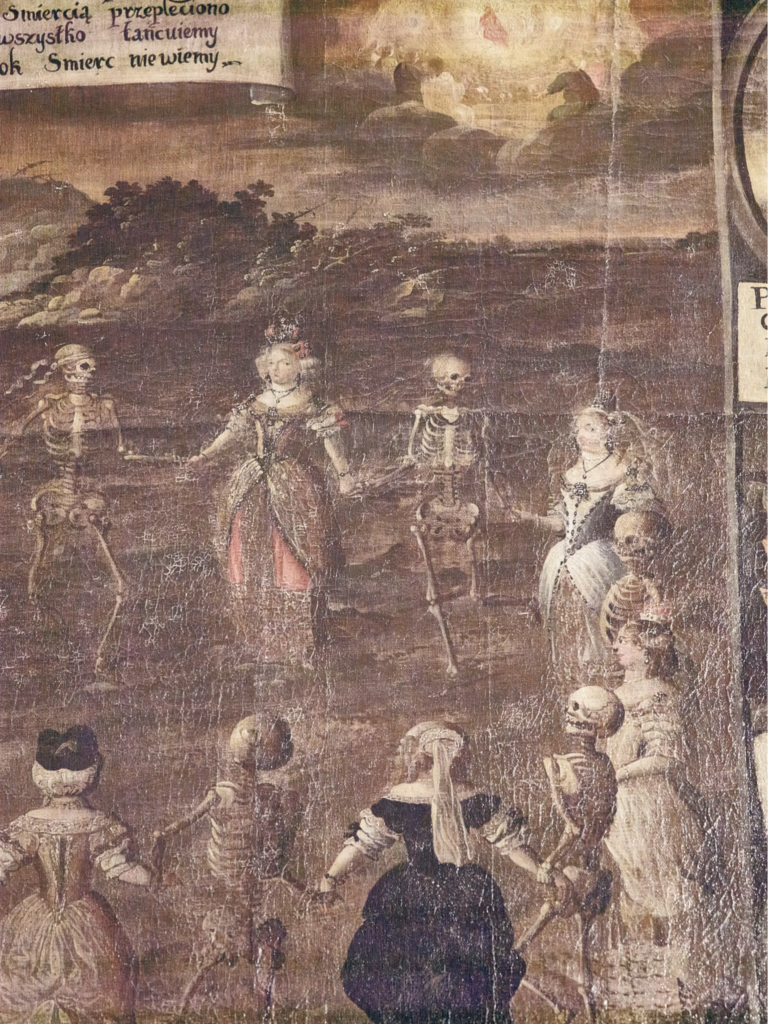
DANCE OF WOMEN AND SKELETONS
201
SLOVENIA
HRASTOVLJE CERKEV SVETE TROJICE
In Hrastovlje, a town in southwestern Slovenia, we can enjoy the church of Cerkev sv Trojice, surrounded by a wall that gives it a spectacular appearance.
These ancient lands have a long history of warfare, and during the 16th century the threat of the Sublime Ottoman State forced the people to build a strong wall around the church, seeking protection.
The original church is a subject of controversy, as some think it is Romanesque, dating from the 12th century, while others think it belongs to the architecture of the early Venetian Renaissance, from the 15th century.
Strong stones were used in the construction of the church, with a roof made of thickpaneled tiles, as was customary in this Mediterranean region.
As usual, the original design was modified over the centuries, although its appearance did not change much.
Its interior walls are completely decorated with paintings, highlighting a Dance of Death, a fresco painting of 3 feet high and 19.76 feet long, made by Jean of Kastav in 1,490. Despite the passage of time and circumstances, the paintings are well preserved.
The dance is somehow different from classical dances. There are no associated texts. The eleven characters do not dance, but walk.
The most important characters start on the right side, just as we contemplate the painting.
As usual, the pope is first, and his skeleton points to the grave. Then come the king, the
queen, and the cardinal. Next are the bishop, the burgher, the monk, the merchant, the nobleman, the beggar, and a child.
The only skeletons that carry accessories are those that accompany the bishop and the beggar.
It is very clear that the merchant is trying, unsuccessfully, to bribe his skeleton with the coins of his bag.
In the end, the child is a symbol of hope, a new life.
204
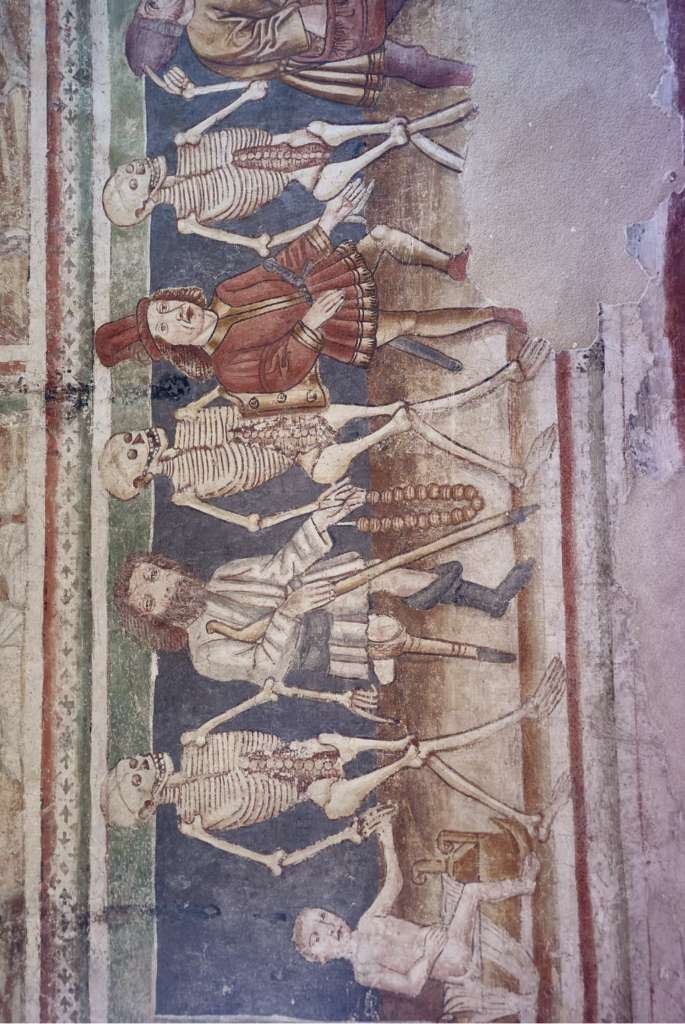
CHILD, BEGGAR, NOBLEMAN
205
SPAIN
NAVARRA CASTILLO DE JAVIER
The Romanesque tribute tower, dated around the 10th century, is the oldest known part of the current Javier´s castle.
Over the centuries it has undergone great transformations, and today, contemplating it allows us to enjoy its extraordinary beauty.
At the bottom of the west tower is a small chapel, which was the private oratory of the inhabitants of the castle. The chapel, a long and narrow space, was built around 1,490.
A Gothic image of the Santo Cristo de Javier, presided over the chapel since the 16th century. This image, made of walnut wood and French style, is popularly known as the smiling Christ, and it is accompanied by the symbols of the Passion.
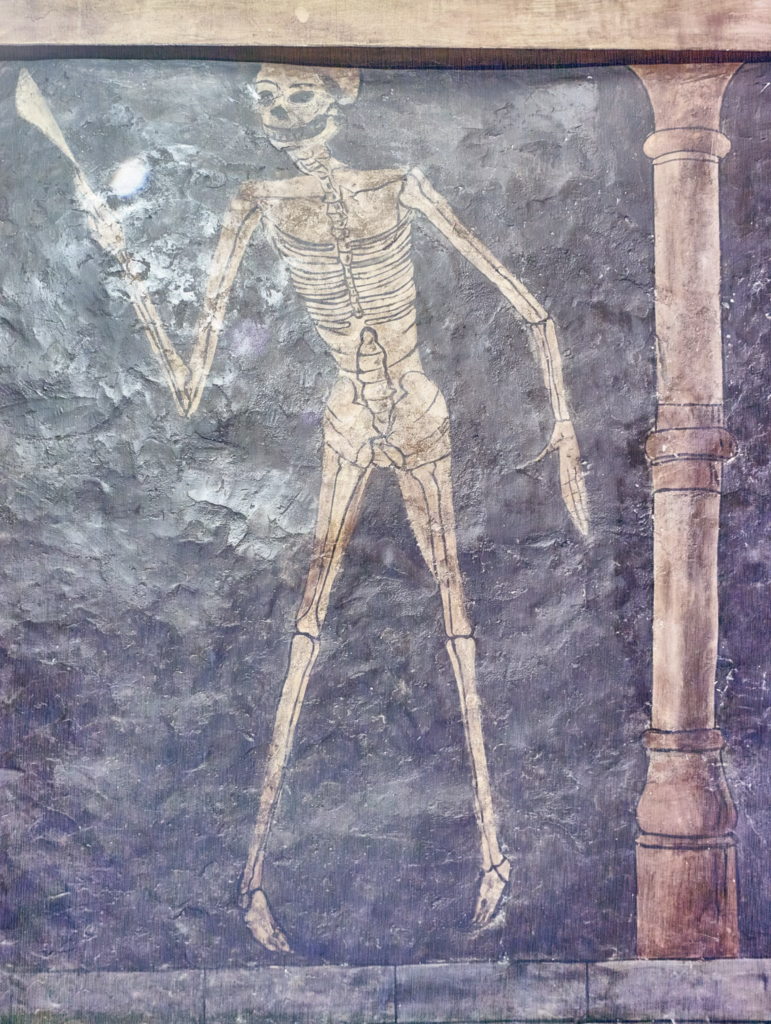
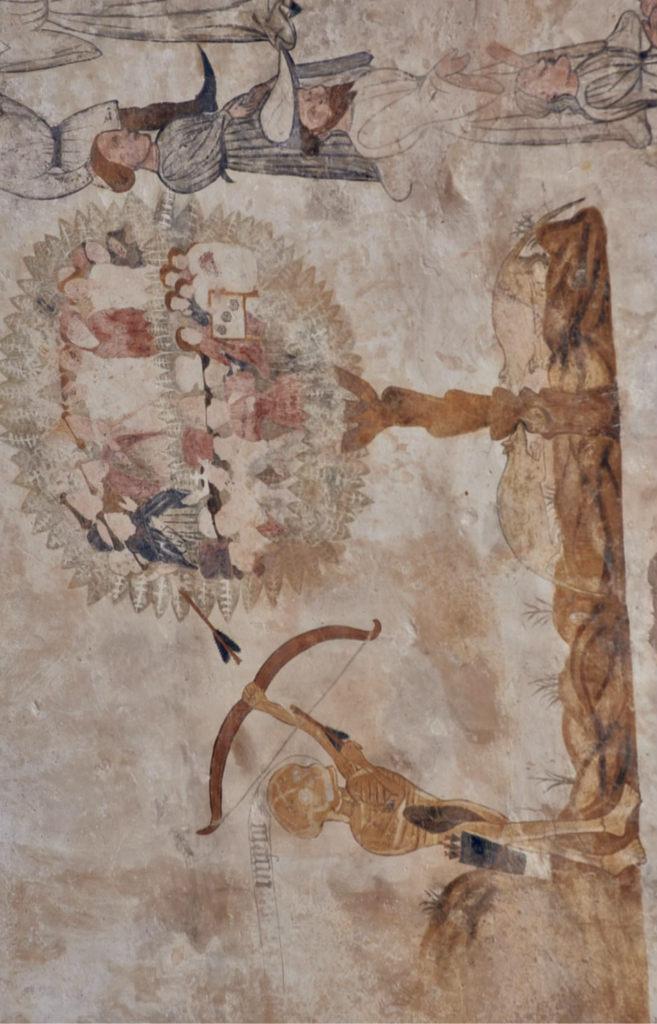
For a long time the chapel was decorated with acanthus leaves until 1,970, when it was removed and the fresco painting of the 8 skeletons was discovered.
The paintings on the walls have about 1,500 sq ft., and are dated around 1,510.
A surprising fact is that in the usual paintings related to the Dance of Death, there are always skeletons and living couples, so the representations in this chapel are exceptional.
Each side wall has 3 skeletons, plus 2 more above the entrance door.
Although the painting has an advanced Gothic style, the perspective of the platform where the figures are located, and the balusters, are in a style close to the Renaissance.
Each skeleton is placed between Renaissance columns.
Some of the skeletons have phylacteries, which in Gothic texts speak of the Latin “memento morti”, a clear reference to the limits of our lives.
Only a few colors were used by the unknown painter.
A striking black color surrounds the skeletons, the same color used to draw their bodies.
The skeletons are ochre-coloured ; their phylacteries are white; the columns are reddish ochre.
The faces of the skeletons are equally astonishing ; they seem to speak to us ironically, without wishing to provoke fear.
A very dense protective varnish layer was applied to the restoration, so now they look like oil paintings.
Due to its small size and in order to preserve the paintings, the chapel is currently closed. In a room near the chapel, we can see a life-size reproduction of the paintings.
217
211
DEATH AND TREE OF LIFE
227
GIRONA VERGES
The town of Verges is located on a plain in Girona.
Its oldest references are from the 11th century, related to its castle, that over time became a fortified enclosure. Today, the medieval village is a beautiful collection of streets with a main square and a church, surrounded by the remains of the ancient wall.
Today, Verges is perhaps the only European site where “La Dansa de la Mort”, “The Dance of Death”, is preserved.
In the Middle Ages it was a common event, which was lost over time.
In Verges it was recovered in the 17th century, included in the catholic Holy Thursday procession. The procession begins at midnight, with Jesus Christ walking through streets lit with torches toward his crucifixion.
A huge crowd of believers, most of them carrying candles, fills the narrow streets.
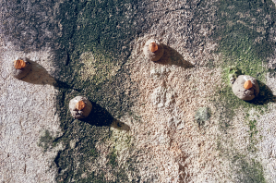
A very original detail is a street, known as Los Caragols, where the procession is illuminated by the light of lamps made from small snail shells filled with oil.
Due to the changes made by the Christian religion, this dance is different from those performed in the Middle Ages, usually in a row or circle.
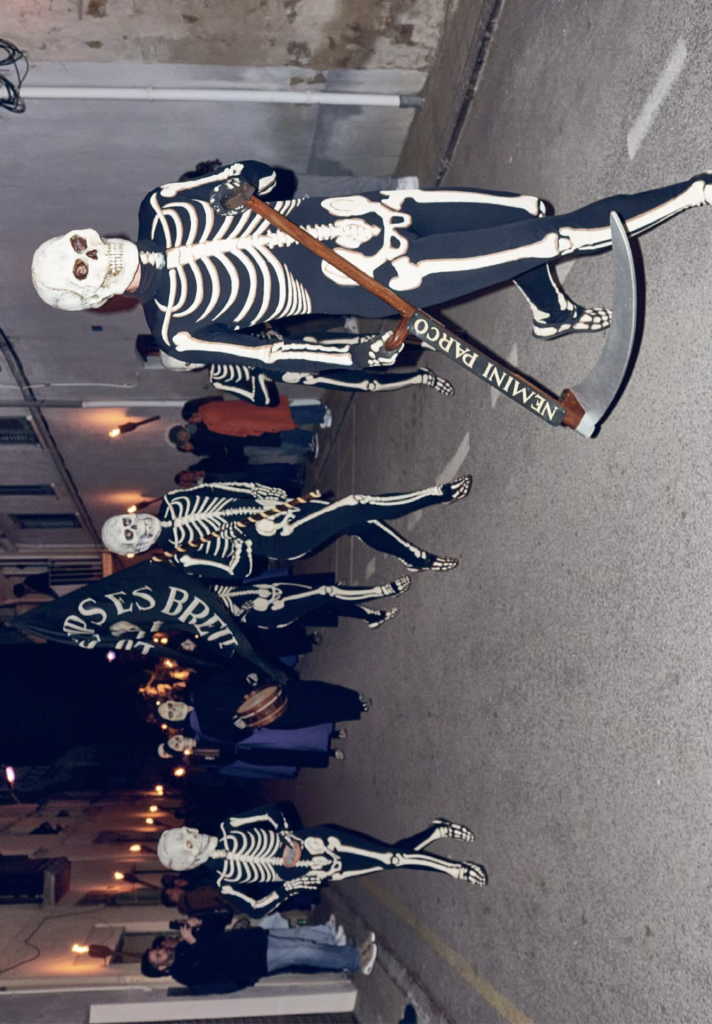
Five dancers, in the middle of the procession, perform the Dance of Death, walking to the beat of a drum played by a hooded musician wearing a black robe, his face a striking white skull. Two similar figures escort him, carrying torches. The dancers are dressed in black costumes, in striking contrast to their white-painted skeleton and a grim white skull.
The dance is started by the “capdanser,” “the lead dancer”, who carries a large scythe.
The scythe bears the inscription «Nemini Parco», «I don’t forgive anyone». As he walks, he stops from time to time, turning around, with the scythe cutting the crops. But now it’s a symbolic move, because in reality he’s cutting short the lives of everyone around him.
«L’abanderat», «the flag bearer», follows him. He carries a black flag, with white words in both sides, that tell «Lo temps es breu», «time is short», and «»Nemini Parco».
Now two dancing children appear, each carrying a saucer of ashes. This symbolizes the transience of human life: «Pulvis estis et in pulverem reverteris», «Dust you are and to dust you shall return.»
The last dancing child holds an old clock without hands. This implies the lack of logic that acts on our lives ; one must be prepared at all times, because the arrival of death is unpredictable.
Throughout the procession, the dancers perform ritualized steps: they walk, dance, and stop. Finally, the procession is split. Jesus Christ is crucified in the main square, and then the Descent from the Cross takes place. Meanwhile, the Dance of Death enters the church to pay homage to the Blessed Sacrament.
Death, having imposed itself upon humans, interpreting the torment of Jesus Christ, announces its imminent victory with the redemptive resurrection.
230
MUSICIAN, L’ABANDERAT, CAPDANSER
231
MADRID MONASTERIO SAN LORENZO DEL ESCORIAL
The Monasterio San Lorenzo del Escorial has perhaps the first Castilian version of the three that are preserved of The Dance of Death, a dialogue recorded in a manuscript dating from the end of the 14th century.
In the 15th century, a shorter version of these dialogues was reproduced into a collection of Hebrew aljamiado texts, i.e. Romance vernacular texts copied in Hebrew characters.
In the city of Sevilla, in 1,520, Juan Varela printed the later Castilian version of the dialogues.
The text of all three versions is the same: a rhymed dialogue in which Death greets future victims, people who always try in vain to delay their fate by saying, “No, not now.”
Unlike its contemporary texts, Death is not described in detail and, more significantly, is not characterized as a skeleton, as is often the case in European Dances of Death.
In this dialogue we find an invaluable description of medieval Iberian society, where the three most important religions were Christianity, Islam, and Judaism.
As an example of this amalgamation of cultures, the dialogues include a Muslim clericand a Jewish rabbi. In more detail, and typical of Jewish and Muslim traditions,
Death describes elements associated with the angels of death.
The dialogue shows the social divisions characteristic of its time, starting with the most important and powerful people and ending with the humblest.
However, and as is common to all three religions, no one can escape Death, the destiny of every living being.
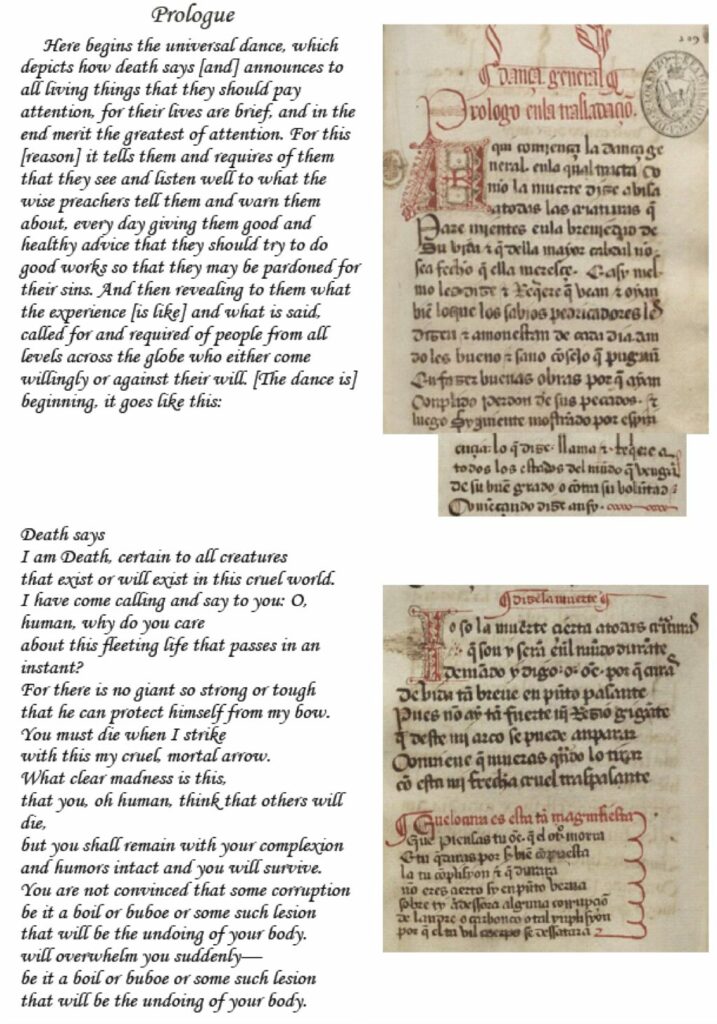
The Escorial version is the earliest and the longest extant manuscript copy with a prose prologue and some 79 stanzas of eight verses each.
The dialogue is included in the Versos al rey D. Pedro del rabí don Sem Tob, 1460-1480.
However, the book is 193 pages long, and the accessible JPG format offered by the library only contains photographs. The dialogues are from page 110 to 130.
Thus, the following texts are the dialogue written in Castilian along with its translation into English, done by Michelle M. Hamilton.
As is logical given the amalgamation of those times, we can also find texts with archaic terms, parts in Provençal, Catalan, Aragonese, etc.
As this is a Dance of Death, Death himself speaks to everyone, saying that all people, regardless of their social position and importance, are subject to his will and will consequently die.
A couple of young women, in an enviable state of being in the prime of life, are the first to die. Then come the men from the highest to the lowest social position, alternating between religious and social figures.
242
243
269
ACKNOWLEDGEMENTS
Croatia. Yes, I agree with you. In this photo, there is no way to closely study the skeletons and people. It was an unfair experience. I arrived at the church ten minutes before closing time, and the lady in charge didn’t give me more time, so I could only take two quick photos.
Estonia. We will be able to enjoy The Dance of Death at the Nigulisti Kunstimuuseum in Tallinn. However, it’s not possible to take high-quality photographs of this painting, as it is covered with protective glass. After contacting the museum’s management and signing the corresponding agreement, I obtained the files I used in this book.
France. Thanks to the administrations and managers of the six locations for their kindness and support.
Germany.
Thanks to the Universitätsbibliothek Heidelberg for its no copyright policy of the Codex.
Thanks to Martin Hagstrøm, for his help regarding the Lübeck painting. Further information : http://www.dodedans.com/Emaria.htm
Italy. All places are easily accessible.
Poland. Thanks to Father Barnaba, Klasztor OO. Bernardynów, Krakow.
Slovenia. It’s not easy. A small room, there are a lot of people, it depends on the goodwill of the woman in charge …
Spain.
Castillo de Javier. Thanks to La Comunidad de Religiosos del Santurario y Centro de Espiritualidad Javier, for their permission and kind support.
El Escorial.
Thanks to Real Biblioteca del Monasterio de El Escorial for its non copyright policy of “Versos al rey D. Pedro del rabí don Sem Tob” :
https://rbme.patrimonionacional.es/s/rbme/item/13418#?xywh=-704%2C-445%2C3853%2C1837&cv=73
Thanks to the help of Michelle Hamilton. Further information :
https://hcommons.org/deposits/item/hc:41839
United States of America. Thanks to the Metropolitan Museum of Art for its Open Access policy.
271